
Rewriting Emotional Memories: The Neuroscience Behind Imagery Rescripting and Memory Reconsolidation
Mar 08, 2026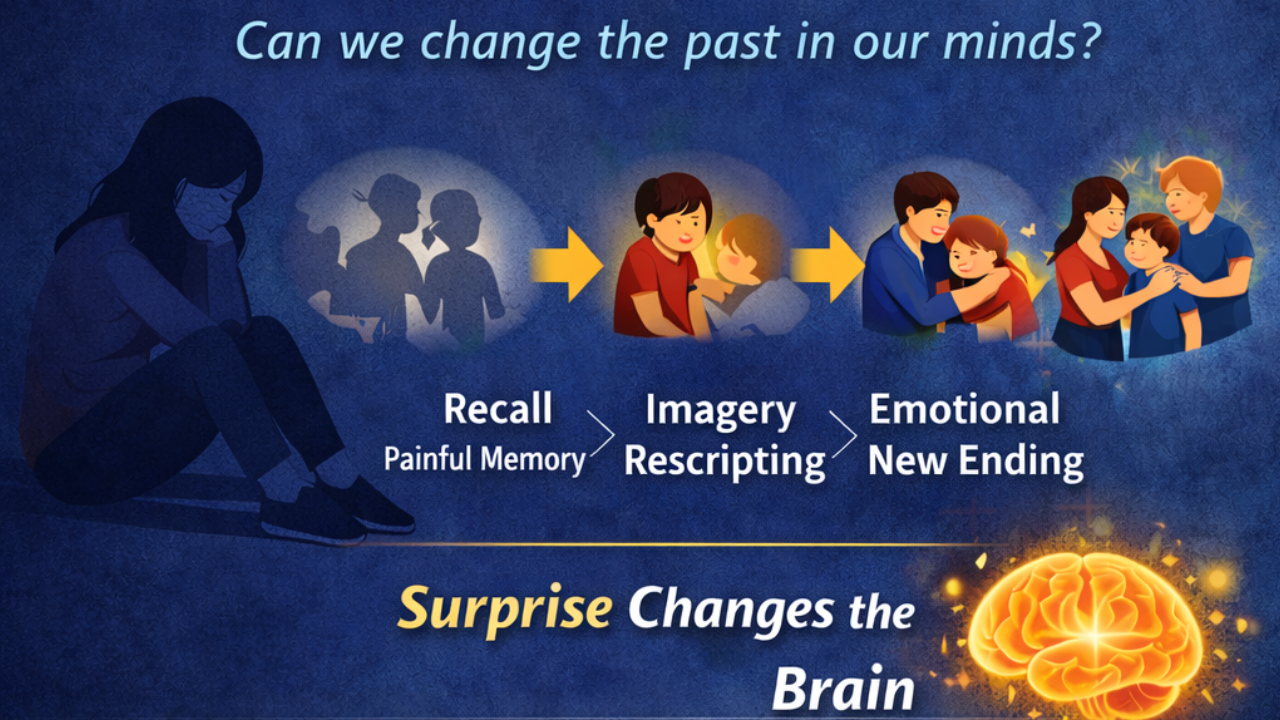
Rewriting Emotional Memories: The Neuroscience Behind Imagery Rescripting and Memory Reconsolidation
For decades, psychology treated emotional memories as something that could be understood, managed, or reframed, but rarely fundamentally changed.
If something painful happened in childhood, the assumption was simple. The brain recorded it. Therapy could help us cope with it.
Modern neuroscience is now challenging that assumption.
A growing body of research shows that memories are not fixed recordings stored permanently in the brain. Instead, they are dynamic reconstructions that the brain updates each time we recall them. This discovery has opened the door to powerful therapeutic methods that can transform the emotional meaning of past experiences.
One such approach, imagery rescripting, has recently been studied in a randomized controlled trial published in Frontiers in Psychology. The findings suggest that revisiting and reshaping distressing memories can significantly reduce the emotional burden associated with them, particularly memories involving criticism and fear of failure (Bączek et al., 2025).
These findings have major implications for hypnotherapy, trauma work, coaching, and emerging approaches based on memory reconsolidation.
The Emotional Origins of Fear of Failure
Fear of failure rarely emerges in isolation.
For many people, it traces back to early experiences of criticism, humiliation, rejection, or conditional approval. A child may receive subtle or explicit messages such as:
• Mistakes are unacceptable
• Performance determines your worth
• Failure will lead to rejection or shame
Over time, these experiences become encoded as autobiographical emotional memories. The brain not only remembers what happened. It also learns emotional predictions about what those experiences mean.
As adults, people may consciously know that mistakes are part of growth. Yet their emotional nervous system still reacts as if failure threatens belonging or safety.
This pattern can manifest as:
• performance anxiety
• perfectionism
• procrastination
• avoidance of opportunities
• imposter syndrome
According to research on fear of failure and performance psychology, early experiences of criticism are one of the strongest predictors of these patterns later in life (Conroy & Elliot, 2004).
The Discovery of Memory Reconsolidation
One of the most important discoveries in modern neuroscience is the phenomenon known as memory reconsolidation.
Researchers discovered that when a memory is recalled, the neural network encoding that memory becomes temporarily unstable. During this brief period, the memory can be modified before it is stored again.
This means that every act of remembering involves a process of reconstruction rather than simple playback.
Neuroscientist Karim Nader and colleagues first demonstrated this effect in experimental research showing that recalled memories could be altered during reconsolidation (Nader & Hardt, 2009).
You can read a detailed overview here:
https://www.ncbi.nlm.nih.gov/pmc/articles/PMC12857063/
This discovery fundamentally changed how neuroscientists think about emotional learning.
Instead of being permanently fixed, memories appear to be continuously updated throughout life.
When new emotional experiences occur while a memory is active, the brain can revise the meaning associated with that memory.
A New Study on Imagery Rescripting
A 2025 randomized controlled trial published in Frontiers in Psychology explored how imagery-based interventions can modify distressing autobiographical memories associated with criticism and failure.
Full study:
https://www.frontiersin.org/journals/psychology/articles/10.3389/fpsyg.2025.1710963/full
Researchers recruited 180 participants who reported elevated fear of failure.
Participants completed four therapeutic sessions over a two-week period, during which they recalled childhood memories involving criticism from authority figures such as parents or teachers.
Participants were randomly assigned to one of three groups:
-
Imagery exposure
-
Imagery rescripting
-
Imagery rescripting with a reconsolidation delay
In the rescripting conditions, participants were guided to imagine a supportive intervention occurring during the memory. For example, they might visualize an adult protector confronting the critic or offering support to their younger self.
The results showed significant reductions in:
• fear of failure
• emotional distress when recalling the memory
• physiological stress responses
Importantly, these improvements remained present at three-month and six-month follow-ups (Bączek et al., 2025).
A summary of the findings was also reported by Neuroscience News:
https://neurosciencenews.com/imagery-rescripting-fear-of-failure-30215/
The researchers concluded that imagery-based techniques can make distressing autobiographical memories “less emotionally burdensome.”
Why “Surprise” Helps the Brain Update Memories
One of the most interesting findings in the study involved something neuroscientists call prediction error.
Prediction error occurs when the brain expects one outcome but experiences something different.
For example, if someone recalls a childhood memory in which they were criticized for making a mistake, the emotional brain expects that same pattern to repeat.
Imagery rescripting disrupts this expectation.
Instead of humiliation or rejection, the memory scene now contains support, protection, or understanding.
This unexpected shift creates a mismatch between expectation and experience.
According to neuroscience research, prediction error is one of the primary mechanisms that drives learning and memory updating (Exton-McGuinness et al., 2015).
In the study, participants who experienced stronger emotional arousal during these moments of surprise showed greater reductions in fear of failure.
In other words, when the brain experiences something that contradicts its existing model of reality, it becomes more willing to update that model.
Testing the Reconsolidation Timing Hypothesis
The researchers also explored whether imagery rescripting could be enhanced by deliberately targeting the reconsolidation window.
Participants in one group recalled their distressing memory and then waited approximately ten minutes before performing the rescripting exercise.
The goal was to allow the memory trace to destabilize before introducing the new emotional experience.
Interestingly, the delayed intervention did not outperform the standard imagery rescripting condition.
This suggests that the emotional surprise generated by rescripting may already be sufficient to activate reconsolidation processes.
The brain appears to update memories most strongly when it encounters a powerful contradiction to its expectations.
Connections to Hypnosis, NLP, and Timeline Work
Although imagery rescripting has gained popularity within cognitive behavioral therapies, many of its underlying principles have long existed in other change methodologies.
Practitioners trained in hypnotherapy, Neuro-Linguistic Programming, and timeline therapy have worked for decades with experiential techniques that revisit and transform emotional memories.
For example:
• hypnotic regression allows clients to revisit past experiences in a safe and controlled state
• timeline techniques allow individuals to view events from a dissociated perspective
• perceptual position work introduces new viewpoints and emotional insights
• resource installation associates positive emotional states with past events
From a neuroscience perspective, these methods may work because they activate memory reconsolidation processes while the memory is emotionally active.
When new emotional information is introduced into that network, the brain can revise its interpretation of the experience.
Why Changing the Emotional Meaning of Memory Matters
Many personal development approaches focus primarily on conscious beliefs.
However, emotional responses are often driven by implicit memory systems stored in the limbic brain.
A person may intellectually believe they are capable and worthy, yet their nervous system still reacts with anxiety or self-doubt.
When the emotional meaning of a memory changes, however, the effects can cascade through many areas of life.
Clients frequently report improvements in:
• confidence
• resilience
• leadership presence
• emotional regulation
• creative risk-taking
Instead of reacting to the present through the lens of old emotional learning, the brain begins responding to the world more flexibly and adaptively.
Training Professionals in Memory Reconsolidation Coaching
As neuroscience research on emotional learning continues to grow, many therapists and coaches are seeking practical frameworks for applying these discoveries.
This is one of the reasons I developed the Memory Reconsolidation Coaching Training Program.
This eight-week online training program integrates principles from:
• hypnotherapy
• Neuro-Linguistic Programming
• timeline therapy
• perceptual position techniques
• neuroscience research on emotional memory
Participants learn how to guide clients through experiential processes that allow the brain to update limiting emotional patterns.
Rather than relying solely on analysis or cognitive reframing, the focus is on creating the conditions in which the emotional brain can reprocess outdated conclusions and install new internal resources.
More information about the training program can be found here:
https://www.hypnotherapybreakthrough.com
The Future of Emotional Healing
The science of emotional memory is evolving rapidly.
For many years, therapy focused on helping people cope with their past.
Neuroscience now suggests something more hopeful.
When emotional memories become active, the brain opens a window in which those memories can be updated.
If new emotional experiences occur during that window, the meaning attached to the memory can change.
This insight is reshaping how psychologists understand trauma, fear, identity, and transformation.
The past may always remain part of our story.
But modern neuroscience suggests that our brain’s interpretation of that story is not fixed.
And when the brain changes the meaning of the past, the future often changes as well.
References
Bączek, A., et al. (2025). Imagine yourself as a little girl: Efficacy and psychophysiology of imagery techniques targeting adverse autobiographical childhood experiences. Frontiers in Psychology.
https://www.frontiersin.org/journals/psychology/articles/10.3389/fpsyg.2025.1710963/full
Neuroscience News. (2026). Using imagination to disrupt negative memory traces.
https://neurosciencenews.com/imagery-rescripting-fear-of-failure-30215/
Nader, K., & Hardt, O. (2009). A single standard for memory: The case for reconsolidation. Nature Reviews Neuroscience.
https://www.ncbi.nlm.nih.gov/pmc/articles/PMC12857063/
Exton-McGuinness, M., Lee, J., & Reichelt, A. (2015). Prediction error and memory reconsolidation. Behavioural Brain Research.
Conroy, D., & Elliot, A. (2004). Fear of failure and achievement motivation. Journal of Personality and Social Psychology.
Carlos Casados is a professional hypnotherapist, NLP trainer, and founder of Hypnotherapy Breakthrough in Newport Beach, California. He trains therapists and coaches in memory reconsolidation methods, timeline techniques, and neuroscience-informed approaches to emotional transformation.
SUBSCRIBE FOR WEEKLY LIFE LESSONS
Lorem ipsum dolor sit amet, metus at rhoncus dapibus, habitasse vitae cubilia odio sed.
We hate SPAM. We will never sell your information, for any reason.
